

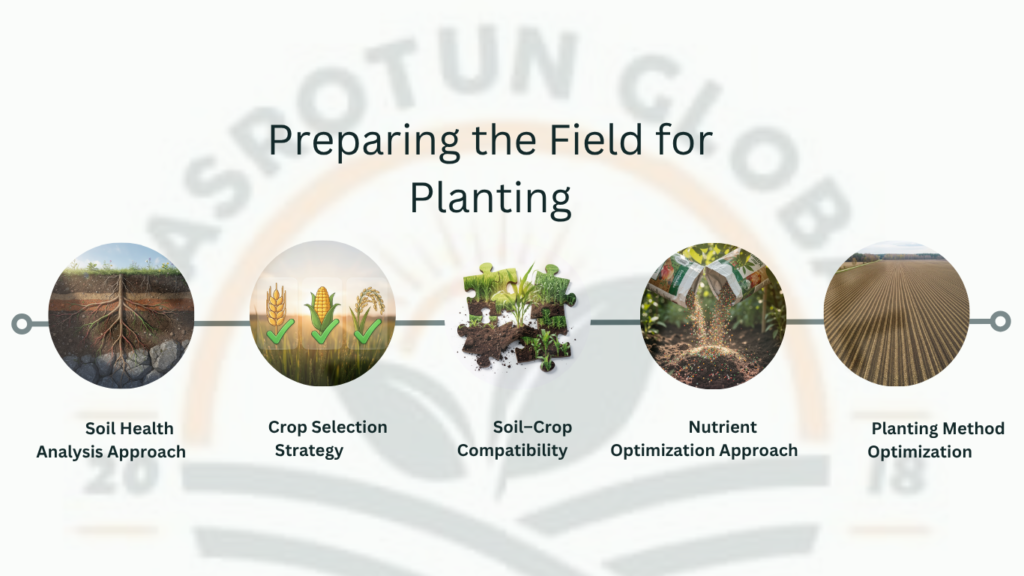
A productive farming season does not begin on planting day — it begins long before that, with careful and intentional field preparation. Many yield challenges that farmers experience during harvest can be traced back to decisions made — or neglected — before the first seed was planted. Proper preparation is not just a routine step; it is the foundation upon which productivity, profitability, and sustainability are built.
The first and most critical step is understanding the health of the soil. Soil testing is not merely a technical process; it is a strategic decision. By analyzing soil pH, texture, and nutrient composition, farmers gain clarity about what their land can support and what adjustments are necessary. This knowledge prevents costly mistakes such as planting unsuitable crops, applying the wrong fertilizers, or experiencing weak germination. When a farmer understands the soil, they eliminate guesswork and replace uncertainty with informed action.
Equally important is selecting the right crop variety. Every crop has specific environmental and soil requirements, and not all varieties thrive under the same conditions. Choosing the appropriate crop for a particular field reduces production risk, improves resilience, and increases the likelihood of strong yields. The goal is not simply to plant what is popular, but to plant what is suitable. When crop choice aligns with soil capability and climate conditions, productivity becomes more predictable and sustainable.
Closely connected to crop selection is the principle of soil–crop compatibility. Successful farming requires harmony between what the land offers and what the crop demands. Matching crops to suitable soil conditions enhances root development, improves nutrient absorption, and ensures efficient water usage. This alignment strengthens plant health from the ground up and protects farmers from avoidable losses caused by poor adaptation.
Nutrient optimization further strengthens this preparation process. Feeding the soil appropriately before planting ensures that crops receive the balanced nutrition required for strong vegetative growth, flowering, and grain formation. Proper nutrient management does not only improve yield quantity; it enhances crop quality as well. Healthy soil produces healthy crops, and healthy crops command better market value. Investing in soil fertility is ultimately an investment in profit potential.
Finally, planting methods play a decisive role in determining field performance. Proper spacing, correct planting depth, and well-aligned rows ensure uniform germination and optimal sunlight exposure. Precision in planting reduces competition among plants, supports better airflow, and maximizes the productive capacity of every hectare. What may seem like minor technical details often determine whether a field performs below expectation or reaches its full potential.
In essence, preparing the field for planting is about reducing risk, managing costs wisely, and positioning for higher returns. It transforms farming from a reactive activity into a strategic enterprise. When preparation is thorough and intentional, farmers are not merely planting seeds — they are planting confidence, stability, and future profit.
