

In a recent discussion on News Central TV, key stakeholders in Nigeria’s agricultural sector addressed a growing concern: falling food prices and the increasing difficulty some farmers face in repaying loans.
While lower food prices may appear positive for consumers, the reality for farmers is more complex. Beneath the surface lies a critical issue that is often overlooked — market timing.
Today, farming success in Nigeria is no longer determined by production alone. It is increasingly determined by how well farmers understand market cycles, policy direction, and supply trends.
The Current Situation: Why Are Prices Falling?
Several major factors were highlighted during the News Central discussion:
1. Government Intervention Through Imports
When food prices rise sharply, government intervention often follows. Even a small percentage of grain imports can significantly impact local markets. As mentioned during the interview, a limited import volume led to a rapid and noticeable drop in grain prices within weeks.
2. Increased Agricultural Budget Allocation
For the first time in Nigeria’s history, agricultural budget allocation increased significantly. While this supports long-term production, it also contributes to increased output and supply in the short term.
3. Release of Hoarded Produce
When import news spreads, traders holding stock may quickly release their produce into the market to avoid losses — creating temporary oversupply and accelerating price decline.
The Hidden Challenge: Loan Timing and Market Assumptions
One key issue raised was that some farmers obtained loans during peak price periods. They projected that high prices would continue. However, when intervention and increased supply entered the market, prices corrected.
This reveals two critical challenges:
- Poor timing of credit disbursement
- Inadequate market intelligence
Agriculture operates in cycles. High prices rarely remain high indefinitely. When prices reach record levels, they often trigger policy responses designed to stabilize the market.
Without understanding this cycle, farmers and lenders alike can miscalculate risk.
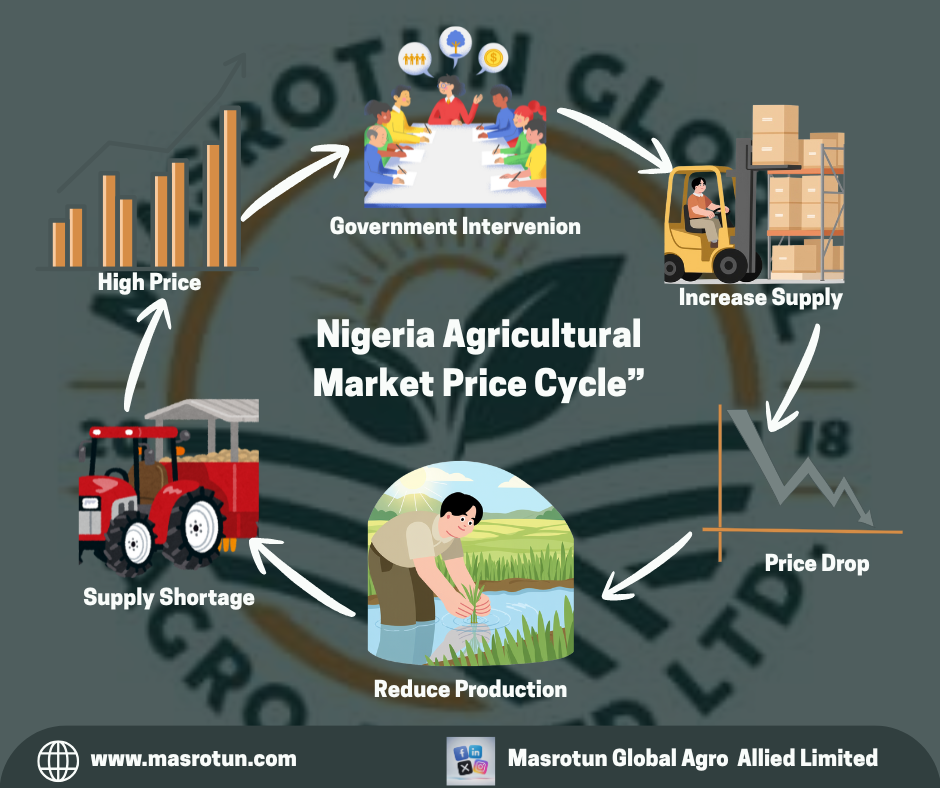
Nigeria’s Agricultural Price Cycle Explained
Nigeria’s agricultural market typically follows a repeating pattern:
Stage 1: High Prices
Low supply or inflation pushes prices upward. Farmers and traders experience strong margins.
Stage 2: Government Intervention
To protect consumers and stabilize inflation, imports or policy adjustments are introduced.
Stage 3: Increased Supply
Imported goods and released local stock flood the market.
Stage 4: Price Correction
Prices decline due to oversupply.
Stage 5: Production Adjustment
Farmers reduce planting the following season due to lower profitability.
Stage 6: Supply Shortage
Reduced production tightens supply. Then Prices rise again — and the cycle repeats.
Understanding this cycle is essential for strategic selling decisions.
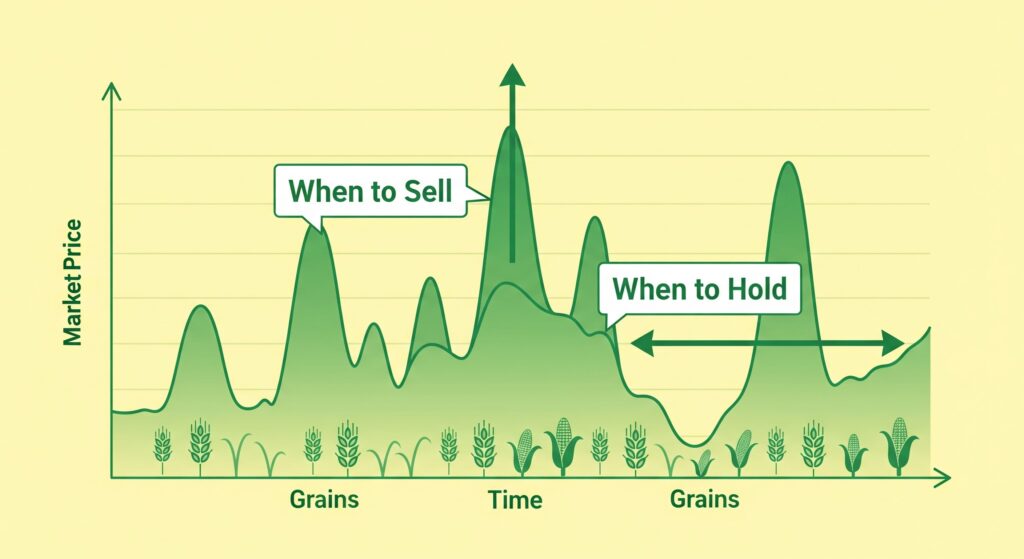
So, When Is the Best Time to Sell?
There is no universal date on the calendar. Instead, farmers must observe indicators.
Consider Selling When:
- Prices are unusually high
- Government signals import plans
- Supply begins increasing rapidly
- Storage costs are rising
- Market sentiment suggests correction
Consider Holding When:
- Supply is tightening
- No policy intervention is announced
- Demand season (festive or off-season scarcity) is approaching
- You have access to safe and affordable storage
- Price trend data shows sustained upward momentum
The best decision is informed — not emotional.
The Structural Gaps: Why Timing Remains Difficult
The News Central discussion also exposed deeper structural issues:
- Limited storage infrastructure (insufficient silos)
- Weak coordination between federal and state food systems
- Financial institutions lacking agricultural field expertise
- Poor real-time market intelligence for farmers
- Credit often disbursed at the wrong stage of the cycle
Without addressing these gaps, farmers will continue to experience the boom-and-bust cycle without strategic control.
Moving Forward: From Reactive to Strategic Farming
The future of Nigerian agriculture depends on a shift in mindset:
Production alone is no longer enough.
Policy awareness is necessary.
Market intelligence is critical.
Timing is strategic.
Farmers must begin to:
- Track policy announcements
- Monitor import trends
- Analyze 3–6 month price data patterns
- Strengthen cooperative aggregation
- Invest in storage capacity where possible
The goal is not just to produce more.
The goal is to produce wisely — and sell strategically.
Final Thought
Falling prices today do not mean permanent losses tomorrow. Agricultural markets move in cycles.
The key question is not:
“When will prices rise again?”
The real question is:
“Will you be positioned correctly when they do?”
Understanding the price cycle is no longer optional. It is essential for sustainable profitability in Nigeria’s evolving agricultural economy.
